home >
energy
energy news | ethanol | cellulose | algae | agriculture | biodiesel | oil/gas | wind | alt energy | carbon credits
energy news | ethanol | cellulose | algae | agriculture | biodiesel | oil/gas | wind | alt energy | carbon credits
7.17.2007
Safety Value (on why it is not good)
Reasons against a safety valve for carbon pricing in a cap & trade system
- Cap & Trade already inherently tempers potential spikes
- Safety valves add risk to the producers of offsets
- Proposed safety valve level ($12/ton) is far below costs of reduction
- Safety valve would be incompatible with global market, preventing integration of US into that market
Discussion/Reference
- NYTimes coverage of compromise proposal
- TerraPass commentary (July 2007)
- MIT economic analysis (pdf)
4.23.2007
Are taxes the best means to cut greenhouse emissions? | Economist
The ambitious goals set by EU leaders in March at the Brussels summit–a 20% cut in greenhouse gas emissions by 2020 and related targets for energy savings, biofuels and other renewable energies–is unlikely to be achieved, at least without the use of environmental taxes to induce changes in businesses’ and consumers’ behaviour. With its consultative green paper issued end-March, the European Commission has now kicked off a wider debate on the subject. Conservation groups, however, accuse the Commission of being too timid.
In contrast to regulatory or administrative approaches, market-based instruments such as taxes and tradable permit schemes offer several advantages as a means of achieving environmental objectives. Whether by influencing prices (through taxation or fiscal incentives) or setting absolute quantities (via tradable permits), they improve price signals, allow industry greater flexibility in meeting objectives, and give firms a longer-term incentive to pursue technological innovations that further reduce adverse impacts on the environment.
At EU level, this approach is embodied in the greenhouse gas emissions trading scheme (ETS), the 2003 directive on energy taxation and the recently revised Eurovignette directive on truck tolls. At national level, ecotaxes generate a modest 6.6% of total tax revenues for the EU-25, of which three-quarters comes from energy taxes and most of the rest from transport (registration and circulation) taxes.
Given the unanimity requirement in the tax area, the green paper does not offer concrete options for fiscal measures but is confined to general considerations, leaving it up to member states to find the right balance in their tax systems.
One general suggestion is that “an environmental tax reform shifting the tax burden from welfare-negative taxes (e.g. on labour) to welfare-positive taxes (e.g. on environmentally damaging activities such as resource use or pollution) can be a win-win option to address both environmental and employment issues.” In this context, reductions in income taxes and social contributions for lower-income households could offset any regressive effect from ecotaxes, while member states could use fiscal incentives to encourage green behaviour and facilitate R&D and innovation. Evidence from tax reforms in the Nordic countries demonstrates such a win-win impact.
A particular focus of the consultation is on revision of the energy tax directive, to link it more closely to the EU’s energy and environmental objectives. One possibility is to divide minimum levels of taxation into two components, one representing the energy content and the other the environmental aspects of a fuel, taking account of differences in greenhouse gas and other emissions. Sectors covered by the ETS could be excluded from the scope of the latter element, thus resolving the problem of potential overlap between the two instruments.
Another major concern is the environmental impact of transport, which accounts for roughly 25% of total carbon dioxide emissions. A pending Commission proposal would introduce a CO2-dependent element in the tax base of registration and annual circulation taxes on passenger cars, encouraging car buyers to take energy efficiency and emissions into account.
Green paper
In a recent paper, the European automobile manufacturers’ association ACEA argues that “CO2-based taxation of cars and of alternative fuels has a significant CO2 reduction potential by shaping consumer demand and setting economic incentives to which vehicle manufacturers and fuel suppliers will respond.” So far 11 member states have such elements in place in their car and/or fuel tax systems, but these differ strongly across the EU, and therefore fail to send clear market signals. As a result, several highly CO2-efficient cars brought onto the market in recent years, in line with ACEA’s 1998 commitment to reduce average emissions, met with very low demand despite considerable marketing efforts. ACEA advocates a harmonisation of car circulation taxes with CO2 emissions as the key criterion, to send simple and clear signals to consumers.
In its green paper, the Commission also has a good word for local charging systems introduced in a number of EU cities, such as London and Stockholm, to improve traffic conditions and reduce congestion. These have significantly reduced CO2 and other emissions within the charged area. There are even discussions at national level, e.g. in the UK and Germany, on extending congestion charging to all roads. The Commission will return to this issue in a green paper on urban transport due later this year.
The European Environmental Bureau, an umbrella group for 140 conservation organisations, found the Commission’s paper too timid. “Basically, the Commission has merely offered its services to EU countries to voluntarily share best practice,” said its secretary-general John Hontelez. “This isn't going to make any difference.” In the EEB’s view, what is needed is a summit agreement on a 10% shift in tax income in ten years, from labour to energy and environment, and on a minimum level of co-ordination to achieve it.
The Commission is seeking reactions to the general ideas and specific questions raised in its green paper. The consultation will close at end-July.
3.24.2007
3.21.2007
2.26.2007
Five western states to bypass Bush on climate - Yahoo! News
5-state pact brings a total of 13 states, comprising x% of the
population and y% of the US economy.
http://news.yahoo.com/s/nm/20070226/pl_nm/emissions_west_dc_1
1.10.2007
CCX: Chicago Climate Exchange
CCX is wholly owned by Climate Exchange, Plc (CLE.L on London Stock Exchange), who also owns the European Climate Exchange (currently the most liquid exchange for EU credits).
Detailed breakdown of eligible offsets
5.24.2006
RealClimate » Climate Science
Blog for climate scientists
Includes (positive) fact-checking review of Gore's movie (Inconvenient Truth)
5.19.2006
Q&A: Pricing Global Warming - Newsweek Business - MSNBC.com
http://www.msnbc.msn.com/id/12839745/site/newsweek/
1.28.2006
Climate Expert Says NASA Tried to Silence Him - New York Times
Climate Expert Says NASA Tried to Silence Him - New York Times
12.29.2005
Goldman sees markets as solution to global warming - Yahoo! News
Goldman sees markets as solution to global warming - Yahoo! News
12.02.2005
US Regional Agreements
Northeast Regional Cap & Trade Agreement
- Signed on Dec 20, the agreement will cap carbon dioxide emissions from power plants at the current levels, from 2009 until 2015. After 2015, incremental reductions will bring the total emissions down 10% by 2020. The agreement covers all power plants that output 25 megawatts or more. A cap & trade system will be employed to provide market incentives to reduce emissions.
- Signed: New York, New Jersey, Delaware, Maine, Vermont, New Hampshire, Connecticut
- Not signed: Massachusetts, Rhode Island - Both bowed out hrs before 12/15 deadline, with Mass governor Romney being the leader.
- Massachusetts: The main stated reason for delay is Gov Romney’s demand (desire?) for a cap on the fees that power plant operators will pay (a market with a price cap?). In the end, the explanation for not participating was the forecasted rise in energy costs (estimated to be $20-30/year). His 12/15 rejection came after a compromise that had the support of the governor’s own advisors. Immediately after pulling from the agreement, Romney announced that he would not be running for re-election (and thereby setting up his run the 08 presidency…this climate position creates differentiation between himself and Gov Pataki as well as Sen McCain).
- Rhode Island: It has been variously reported that Gov. Carcieri (R) shared Pataki’s reservations about the costs to consumers but also had other concerns.
- Terms: freezes carbon dioxide emissions at their current levels; 10% reduction in 2020
- News: Boston Globe (Dec 2), NYTimes (Dec 16), Business Week (Dec 20), NYTimes (Dec 21)
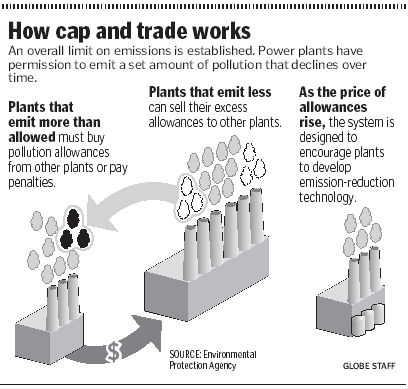
Kyoto credits
Kyoto Terminology
- Certified Emissions Reductions (CER) – the technical term for the credits according to the Kyoto Protocol.
- Clean Development Mechanism -
Forests
- Covered forests must have been planted after 1990
-
Current Carbon Trading Systems
- European Union Emissions Trading Scheme
- Sidney
- Rio Stock Exchange
- Chicago Climate Exchange
